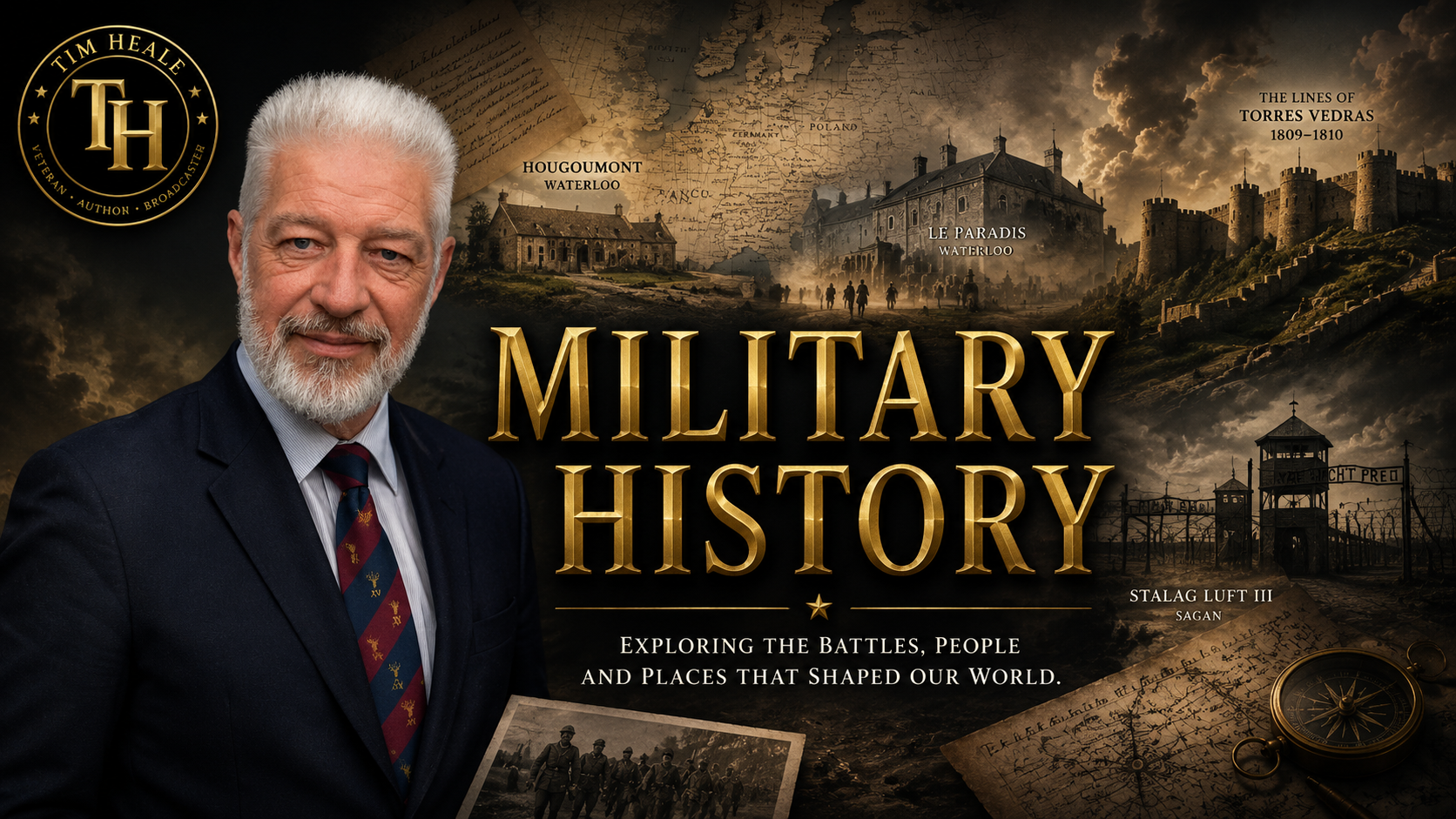
Welcome to Military History
Military history is more than battles and dates. It is about the decisions, courage and sacrifices that shaped the world we live in today. Drawing on over four decades of military service and a lifelong passion for history, I explore the people, places and stories that deserve to be remembered.
The Blücher Story – How One Fortress Changed the Course of History
How Oskarborg Fortress Delayed
the German Invasion
of Norway
On 9 April 1940, during the German invasion of Norway, the guns of Oskarborg Fortress opened fire on the German heavy cruiser Blücher.
The ship was sunk in the Oslofjord, delaying the German advance long enough for King Haakon VII, the Norwegian Government and Norway's gold reserves to escape.
That delay proved crucial, allowing Norway's legitimate government to continue the fight from exile in Britain.
Adding to the significance of the day, 9 April was also the birthday of Queen Maud of Norway.
In accordance with tradition, Oskarborg Fortress fired a 21-gun royal salute in her honour.
Watch the video below to discover how a handful of determined defenders, a nineteenth-century fortress and three ageing guns changed the course of the campaign in Norway.
Stalag Luft III – The Prison Camp Behind The Great Escape
The True Story Behind The Great Escape
Stalag Luft III was one of the most famous prisoner-of-war camps of the Second World War.
Built specifically to make tunnelling difficult, it nevertheless became the setting for some of history's most remarkable escape attempts, including those immortalised in The Wooden Horse and The Great Escape.
In this video, I visit the site of the former camp in Poland to explore its history, remember the men who were imprisoned there, and reflect on the courage, ingenuity and sacrifice that made Stalag Luft III part of military history.
Hougoumont Farm
The Turning Point Napoleon Missed
Hougoumont Farm became one of the decisive strongpoints during the Battle of Waterloo.
What began as a diversion drew in increasing numbers of French troops and helped shape the outcome of the battle.
In this film, I explore the site, the fighting and why Hougoumont mattered so much on 18 June 1815.
Join me as I visit the site and uncover the story behind this remarkable event.
Le Paradis Massacre
The Royal Norfolk Regiment’s Darkest Day
On 27 May 1940, during the retreat to Dunkirk, soldiers of the 2nd Battalion, Royal Norfolk Regiment made a determined stand at Le Paradis in northern France.
After surrendering, ninety-nine men were marched to a barn and machine-gunned by members of the SS Totenkopf Division. Only two survived.
In this film, I visit the site of the massacre and tell the story of the men, the atrocity and the long search for justice.
Join me as I visit the site and uncover the story behind this remarkable event.
Join me as I visit the site and uncover the story behind this remarkable event.
The Lines of Torres Vedras
Wellington's Secret Defensive Masterpiece
Built between 1809 and 1810 under the direction of the Duke of Wellington, the Lines of Torres Vedras were one of the greatest defensive systems ever constructed.
More than 150 forts, redoubts and artillery positions stretched for almost 80 kilometres north of Lisbon.
Hidden from the French until the last moment, they helped stop Marshal Masséna's invasion of Portugal and ultimately changed the course of the Peninsular War.
Take a closer look at Fort St. Vincent, one of the best-preserved forts in the Lines of Torres Vedras.
Evora
Portugal's Timeless UNESCO Treasure
Leaving the Lines of Torres Vedras behind, my journey continued to the historic city of Évora.
A UNESCO World Heritage Site, Évora has witnessed more than two thousand years of history, from the Romans and Moors to Portugal's Age of Discovery.
Walking its cobbled streets, visiting the Roman Temple, cathedral and ancient city walls, it's easy to understand why Évora is regarded as one of Portugal's finest historic cities and an essential stop on any journey through the country's past.
Join me as I visit the site and uncover the story behind this remarkable event.